
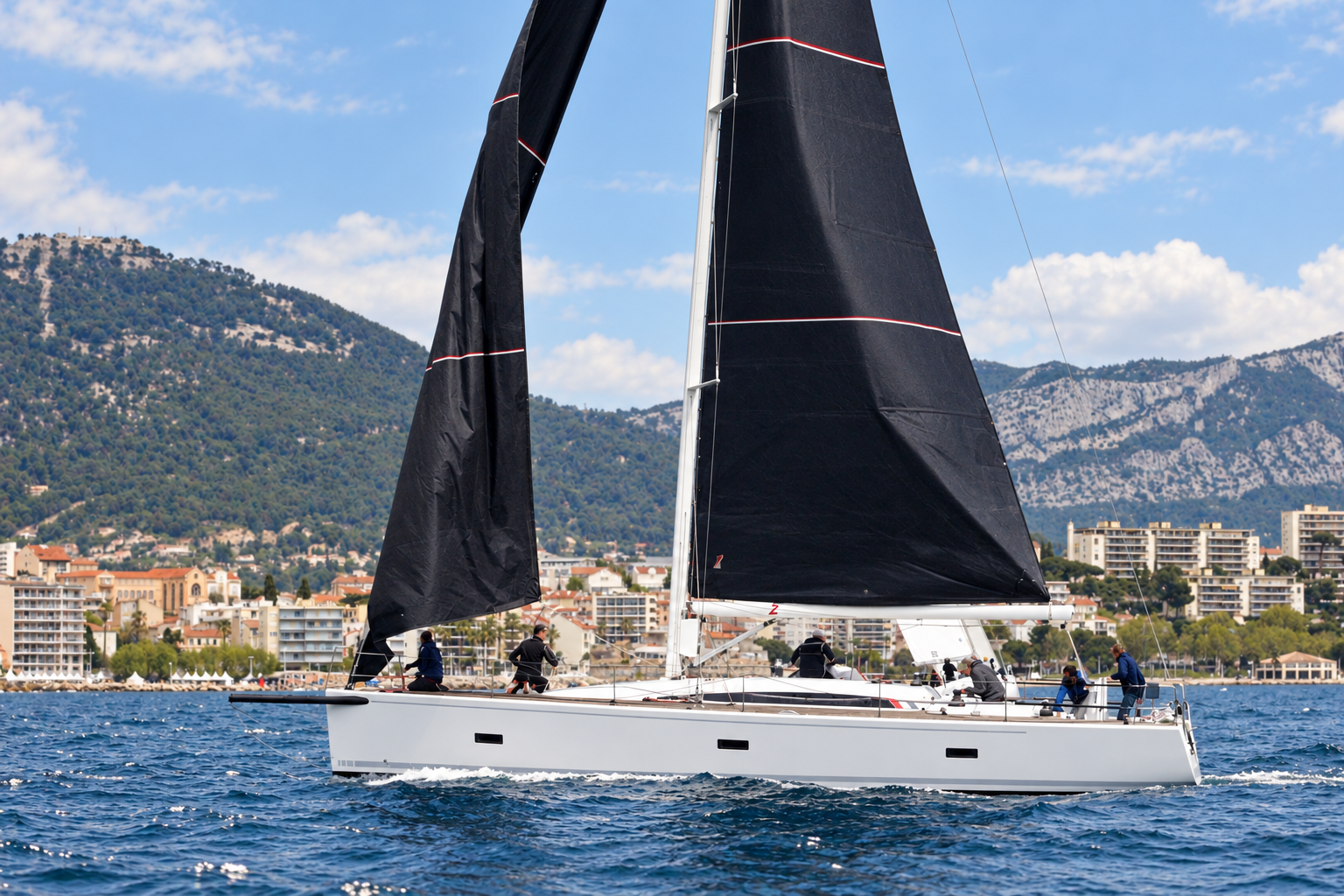
SY BlueMoon
ARC 2026 live tracking
Note: select Tags -> Racing
Ocean sailing –
Across the Atlantic and back
06/2026 – 06/2027
A unique sailing project, set to launch in the summer of 2026, will take a Finnish team from the Mediterranean across the Atlantic to the Caribbean and back to Europe. The experienced crew’s aim is to compete in top-tier international sailing events ARC 2026 and to showcase Nordic sailing culture on the world stage.
The journey combines competition, storytelling and collaboration – offering experiences, visibility and content both at home and internationally. Letest feelings and pictures from Instagram @sybluemoon.fi
Follow latest news of BlueMoon on Instagram

Blog
Mediterranean Delivery Passage: 23–26 July 2026, Toulon, France – Torrevieja, Spain
The third transfer sail took place in July. Third time lucky. The first two attempts had ended in withdrawal. Juuso, Timo, Antti and Janne set off on the trip. Kyösti from Rovaniemi and Sami from Hämeenkyrö agreed to help out. The reconnaissance and fire station preparation team consisted of Janne, Kyösti and Sami. We set off from Helsinki on the morning of 22 July, and the flight from Helsinki to Nice arrived before midday. We took with us the struts for the mast collar, a repaired pedestal and a pre-assembled mount for the Starlink dish on the aft deck. At the railway station in Nice, it took a bit of faffing about to find the right platform for the train to Toulon. It was sweltering, and with our luggage in tow, we were dashing about all over the station in every direction. We finally arrived in La Seyne and took a taxi to the harbour.
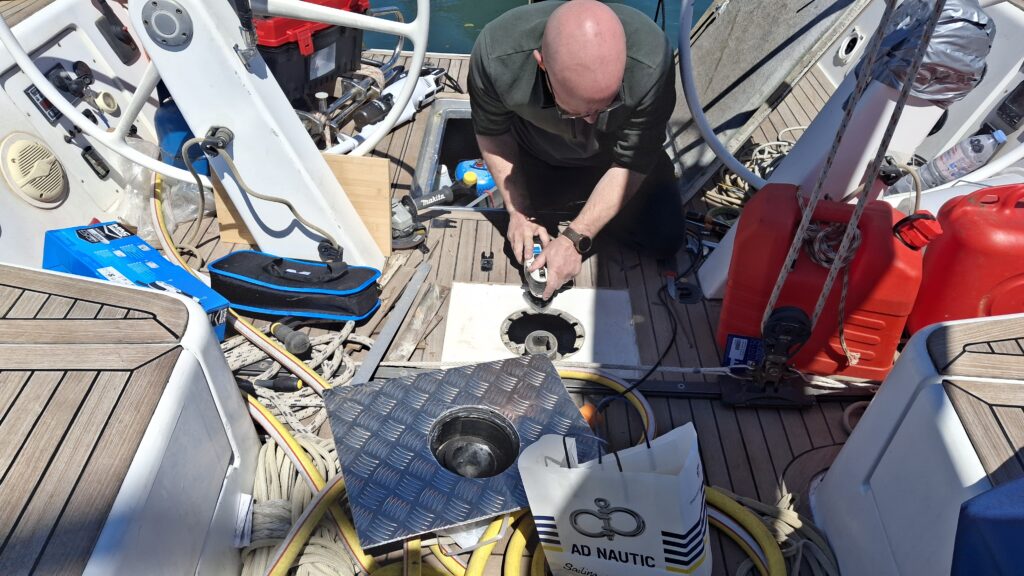
Checking the rudder bearing mounting required a small epoxy filler injection. I popped into town by taxi and picked up a few syringes from the chemist’s. The job was a success and the rudder bearing was finished off with sheet metal. We had to fit a grommet for the kitchen sink and the fridge drain pipe. This needed replacing due to a leak that had developed. By evening, our pleasure boat was ready for launch.
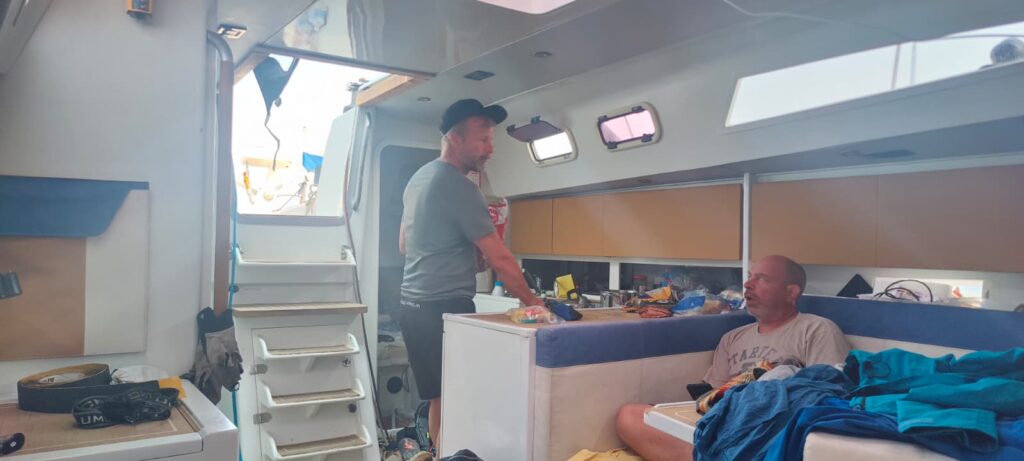
At this stage, the lack of rational thinking caused by our deteriorating diet nearly drove our strike team to a nervous breakdown. We faced the challenge of finding the location of our accommodation amidst a jumble of instructions. After a huge effort, we finally found the neat Airbnb flat we’d booked near the harbour. Time to wash, eat and sleep.
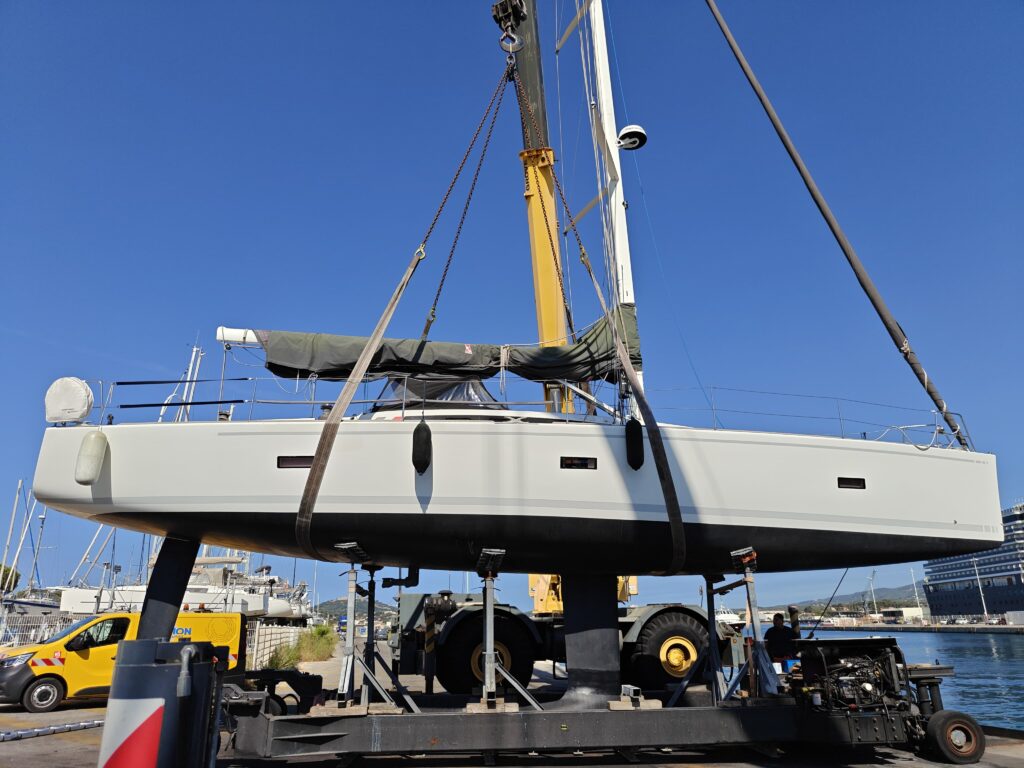
On the morning of Thursday 23 July, the friendly crew at the harbour launched the boat. At this stage, the repaired pedestal was fitted, and at the same time the night-light LEDs were installed on the steering consoles. Then it was time to stock up. We filled the boat with provisions and water. The rest of the crew – Antti, Juuso and Timo – arrived. We fixed the mounting for one more railing post. As evening fell, we bid farewell to LaSeyne and set course, the bow pointing towards the darkening horizon and the Iberian Peninsula.
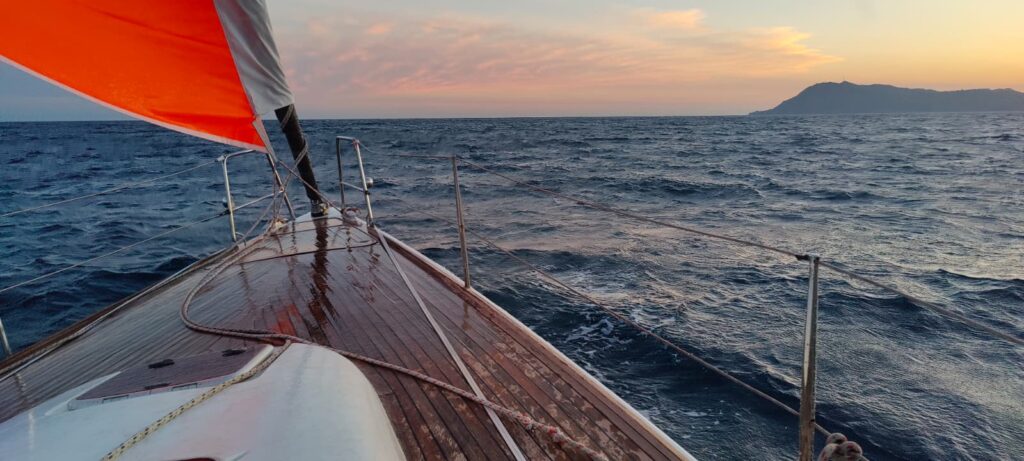
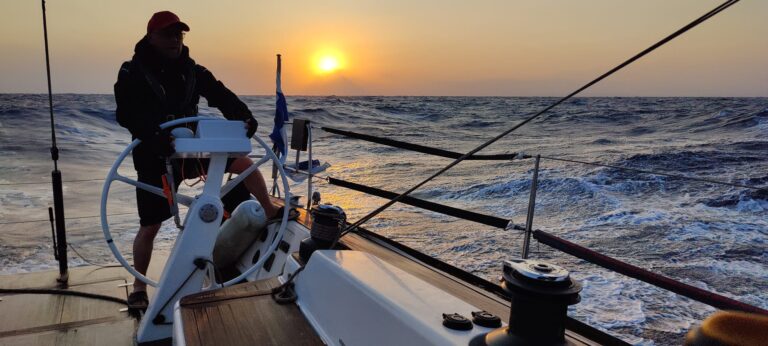
The wind is just under 10 m/s and the swell is around one and a half metres. For the night, we hoisted the third reef on the mainsail and set the storm jib at the bow. We got the watch rota going and set off to plough through the sea. For many of us, this was our first night’s sailing on the open sea. The starry sky is always worth raving about. The boat handled the conditions beautifully and the wind was just right.
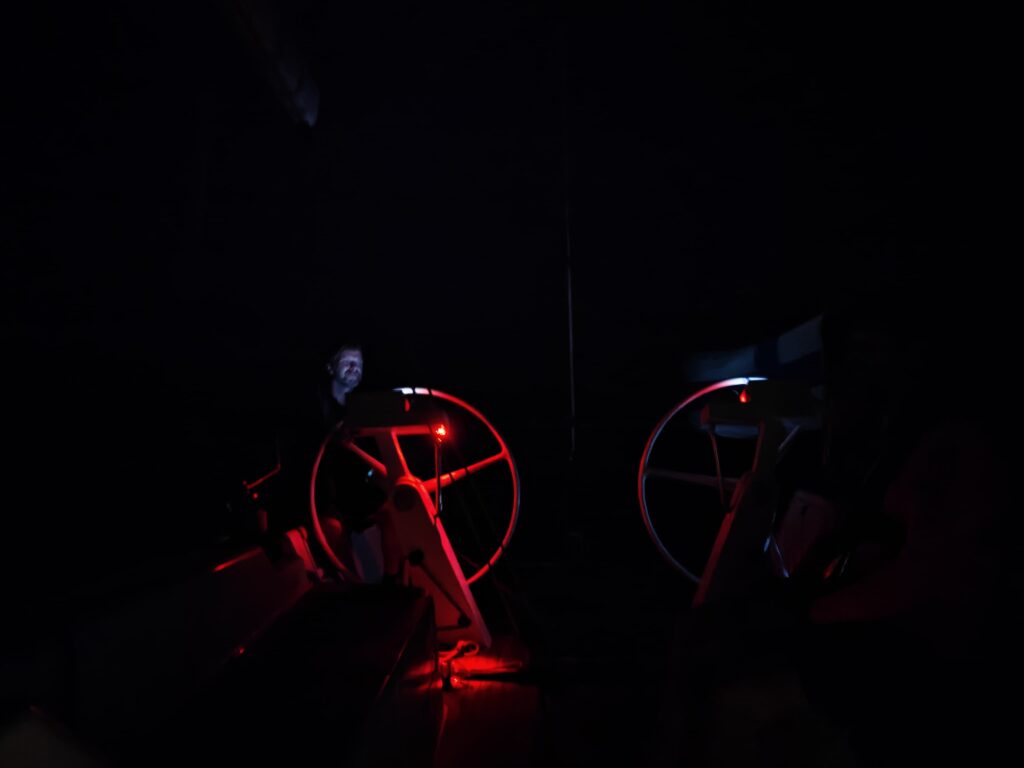
In the morning, we took down the reef and hoisted the roller-furling genoa. The fastening for the jib in heavy weather tore away as we were taking it down. The seamstress had her work cut out for her. Early on Friday 24 July, we realised the fridge had defrosted. No need to sip cold drinks on this leg of the voyage. That’s what we concluded. Kyösti set about preparing the minced meat and whatever else could be deemed edible. At the bottom of the fridge, a sludge of fat and all manner of melted substances was sloshing about. The air in the boat became noticeably fresher after cleaning out the fridge. For the rest of the trip, we lived on youth camp food, pasta and noodles. You’ve always got to have some dried rations to hand, just in case! Later on, the fault was rectified by replacing the compressor’s control board.
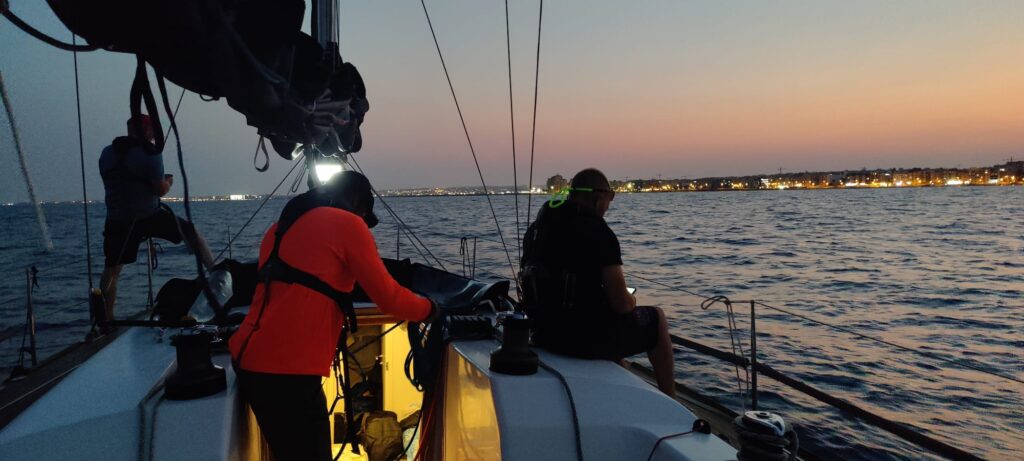
There was a reasonable amount of wind, and during the night the sea was considerably calmer than before. The following day, Saturday 25 July, we sailed long stretches across choppy waters under engine power. Land in sight! We passed Ibiza and Mallorca in the afternoon. We stopped off, of course, for a swim and a wash. There were dolphins about that day. After our swim, the engine started to splutter. We found the coarse filter was full of seaweed. We cleaned it and checked the paper filter as well. We found that one needed replacing too. We bled the system and carried on our journey. We monitored the situation and, a short while later, the same thing happened again. We cleaned the coarse filter, bled the system and carried on. This was repeated once more, and after that the engine didn’t need any further attention.
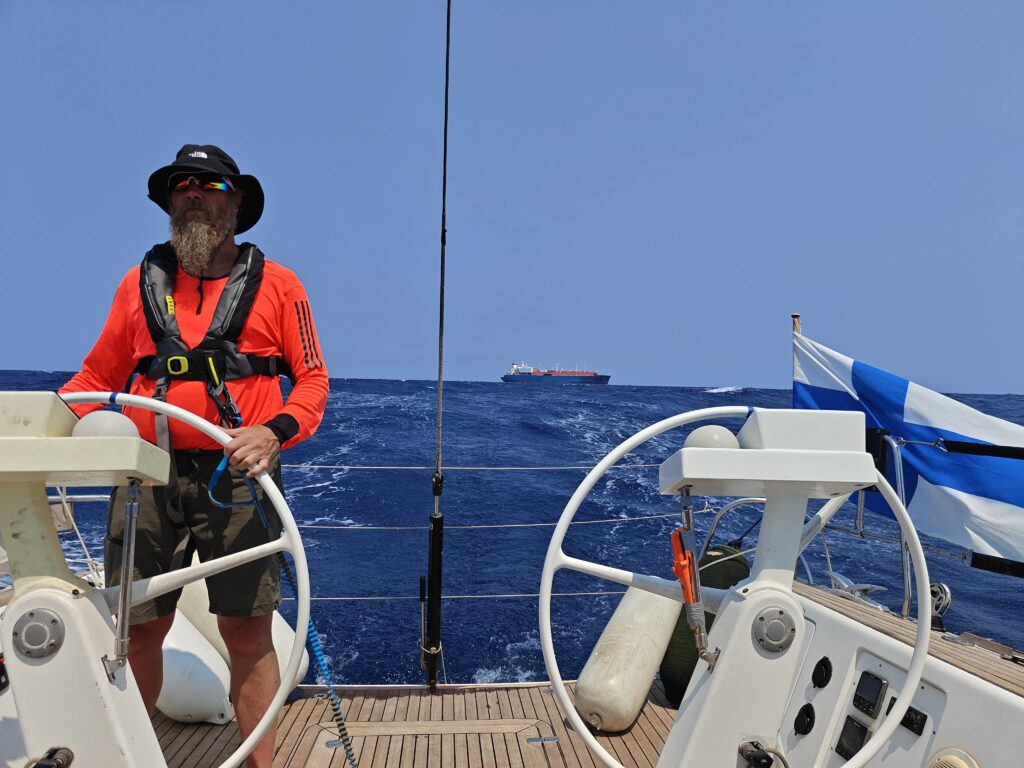
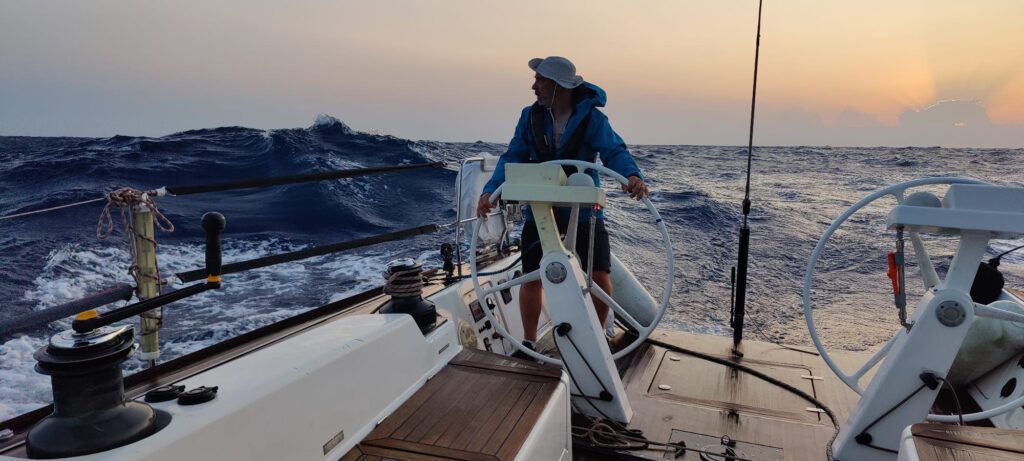
The wind and swell picked up during the night. We adjusted the roller-furling system slightly and set the third reef on the mainsail. Sailing in 3–4-metre swells at night was a new experience for many of the helmsmen. When the bow plunges downwards in pitch-black darkness at sea, that first time certainly sticks in your mind. The SLY47 really is a brilliant boat to sail. No trouble at all in conditions like that. It’s certainly a wild ride.
In the morning, we noticed that the Windex and VHF antenna had gone missing from the top of the mast during the night. We were able to test the spare antenna, which worked perfectly. There were waves and wind during the morning, but things calmed down afterwards. There was shipping traffic throughout the journey. As we approached Spain, the traffic increased significantly. The lookout monitored it using AIS data and the radar. They’re handy systems. The relaxed final stretch was crowned by the lights of Torrevieja appearing on the horizon in the early evening. We moored at dusk at the berth Tommi had booked. We had a shower and went out for some burgers. A cold Coke was just the thing after a few days of drinking lukewarm water. We’d been at sea for 3 days and 2 hours. The distance covered on this leg was 450 nm.
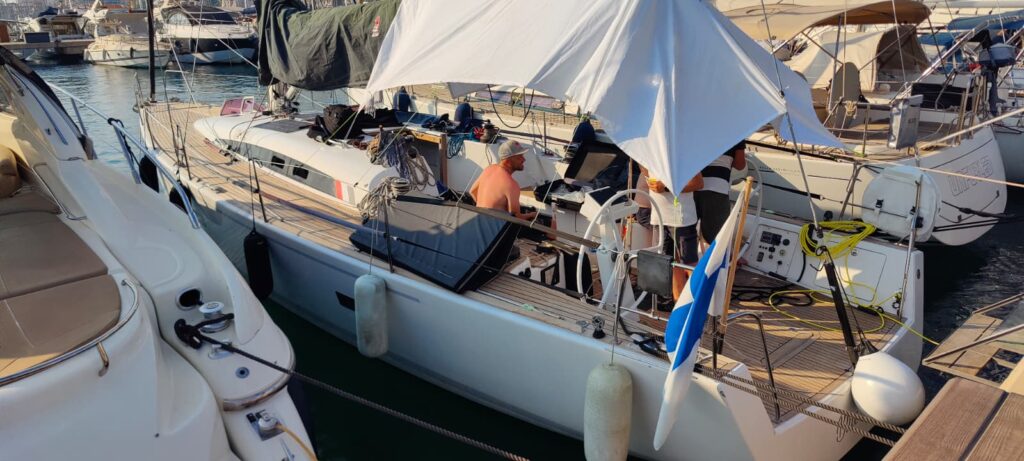
We spent the following day at the jetty carrying out maintenance work. We found that the tank had been cleared of algae. We fitted the Starlink mount, installed new bushings on the boom bracket, inspected the masthead for damage, and did a whole lot more. In the evening, we flew to Helsinki.
Written by Janne
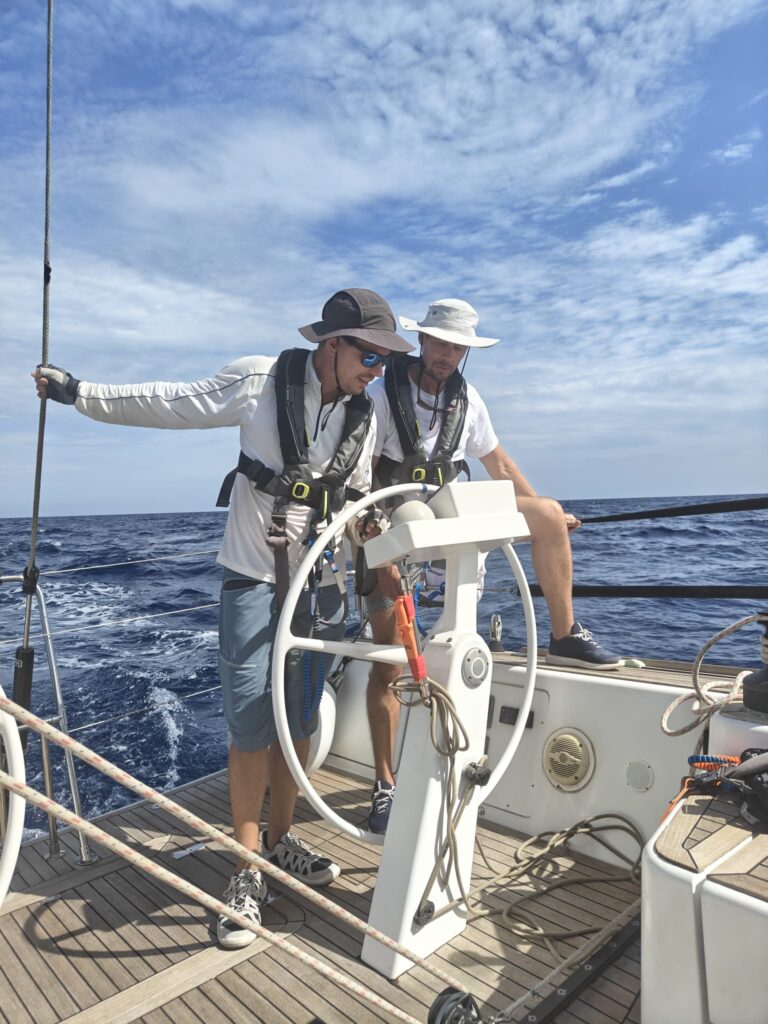
Transfer from Torrevieja to Fuengirola, late September 2026
In Spain, the team spent several weeks sailing and preparing the boat. In the last week of September, it was time to move the boat to Fuengirola, where we stocked up on supplies for the ‘final sail’ before setting off for Gran Canaria with the whole team.
This final transfer before crossing the Atlantic was the responsibility of Tommi and Jere; we took our partners along, and on a couple of legs our twin daughters, Viola and Jade, were also with us.
Shopping trips and swapping sails and the liferaft in Torrevieja were still on the agenda before departure. We’d left some of the sails there for storage, and the liferaft we’d just bought was also left there and put up for sale. We’d gone through the requirements for the offshore racing class in more detail on an offshore safety course in Lohja (the course itself was also part of the requirements), and we realised that our liferaft did not meet the standard required for the open-sea racing class. Well, we had to get a new one.
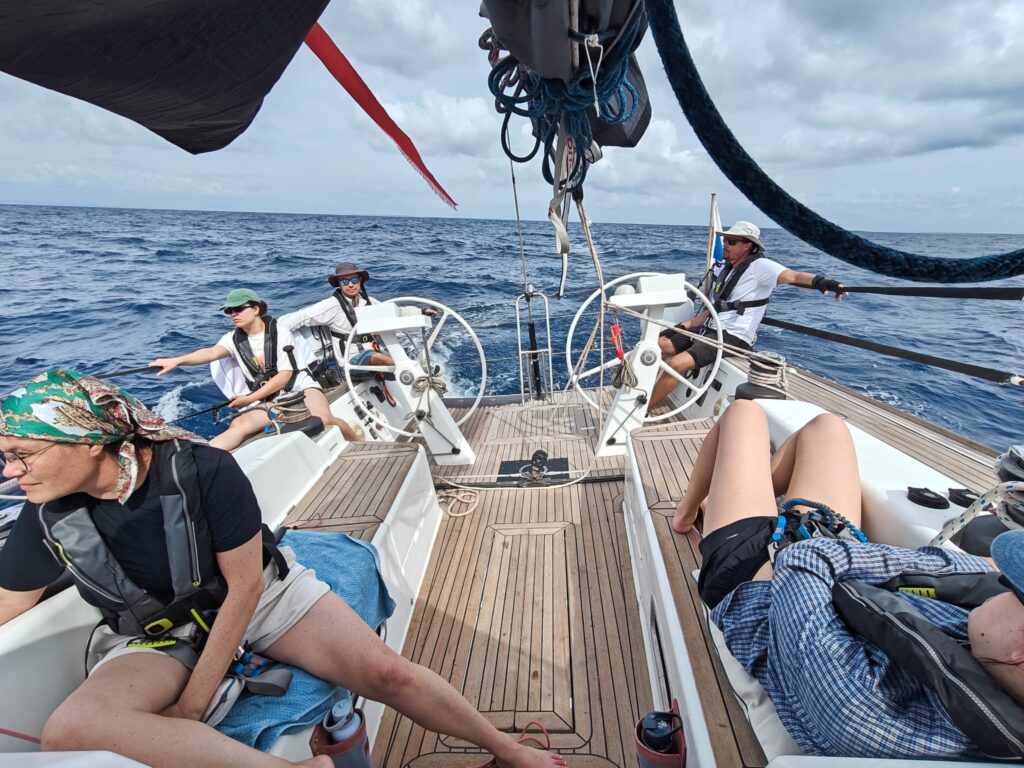
On Monday morning, we set off on the first leg towards Cartagena. At times we had a pleasant crosswind, at others it was almost windless, but with a reasonably steep, old swell, we managed to sail the first leg. Unfortunately, the girls’ stomachs weren’t used to the swell yet, so they were seasick for the rest of the leg.
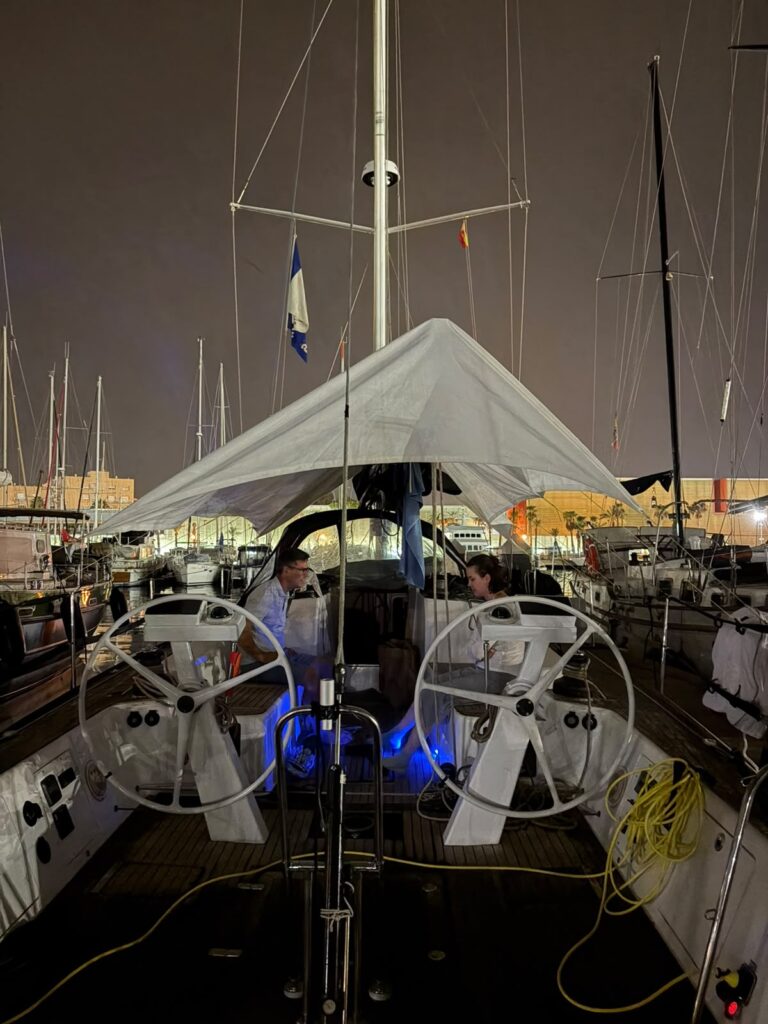
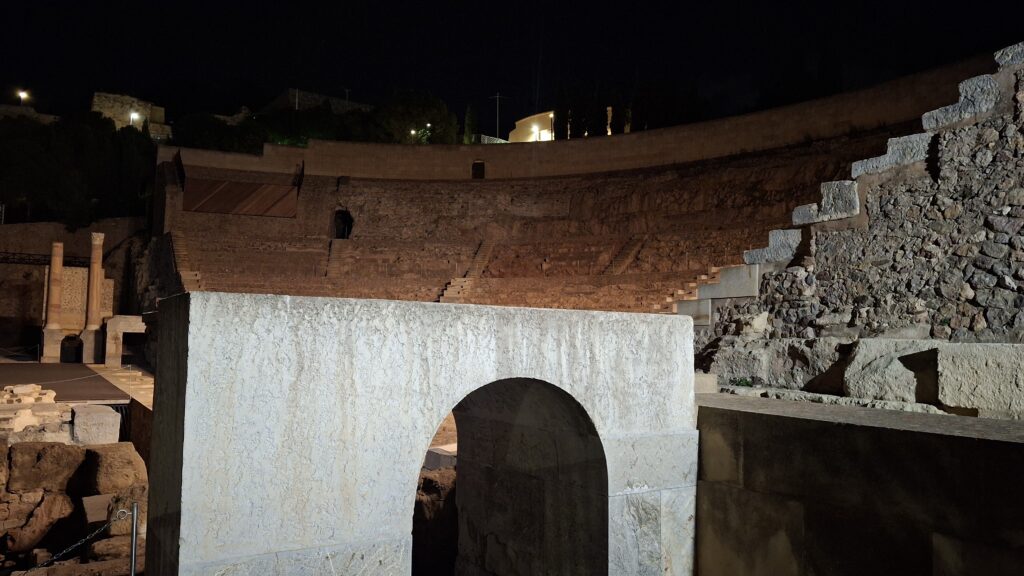
However, the town of Cartagena made the trip worthwhile in the evening. The girls ended up staying there as tourists and only joined us for the final leg of the journey. The town was one of the prettiest Spanish coastal towns I’ve ever visited, with a beautiful and clean old town, and a truly magnificent ancient Roman amphitheatre
.
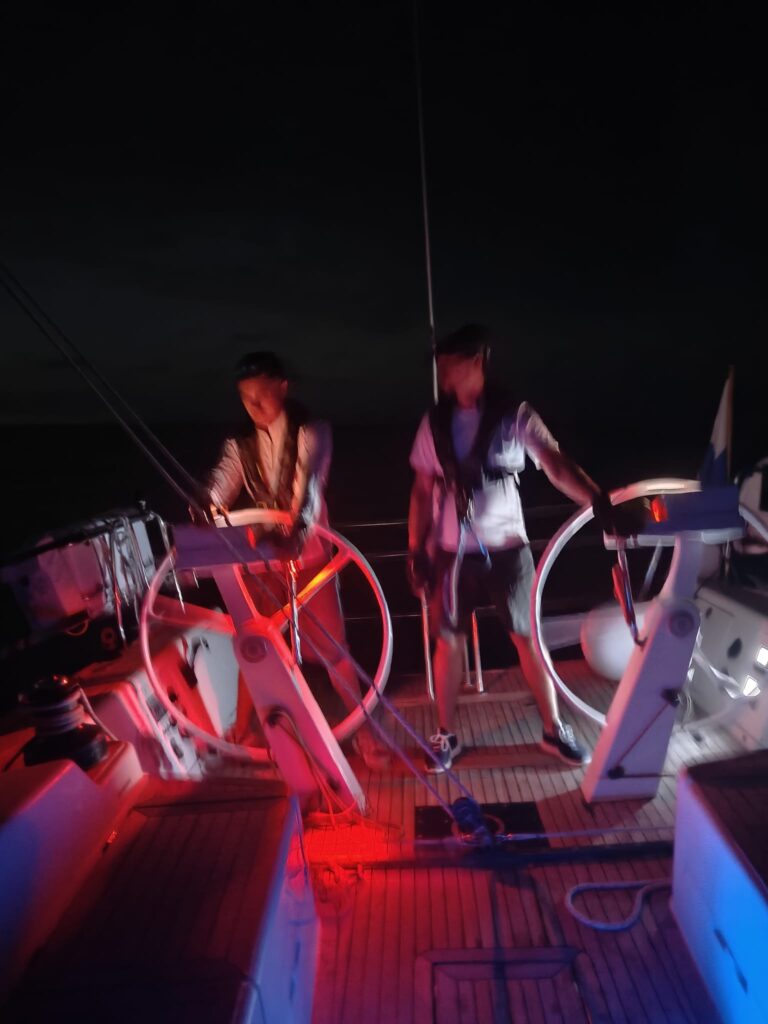
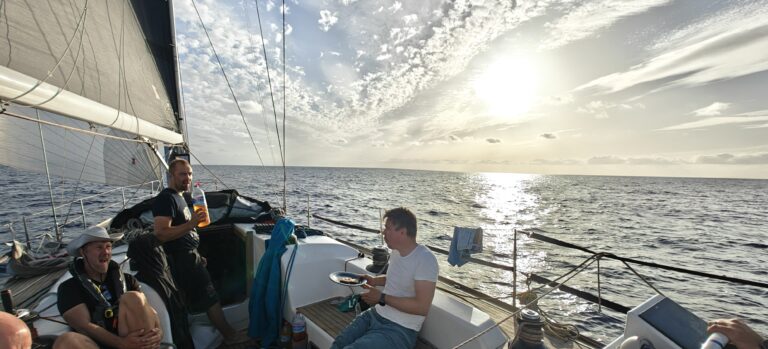
Next, we had planned an overnight sail towards the small “Del Este” marina. The winds were stronger and we managed to sail right up until nightfall; the atmosphere was brilliant, and even the ladies got to experience an overnight sail on the Mediterranean. It was a beautiful night; the half-moon shone brightly, casting a bridge across the sea. The winds shifted frequently, so there was plenty to do even at night. The shifting winds and manoeuvring to avoid the tankers visible on the ASI kept the watch crew awake. There was also a brief lull during the night when we motored for an hour, but then the winds picked up to 5–6 m/s and we hoisted the sails again. In light winds, I managed to tack on my own whilst on watch, using the wind angle with the autopilot.
In the morning, we got to enjoy the Code 0’s capabilities in light headwinds; a wind of just a few metres per second was enough to propel the boat at 4–6 knots – a real pleasure!
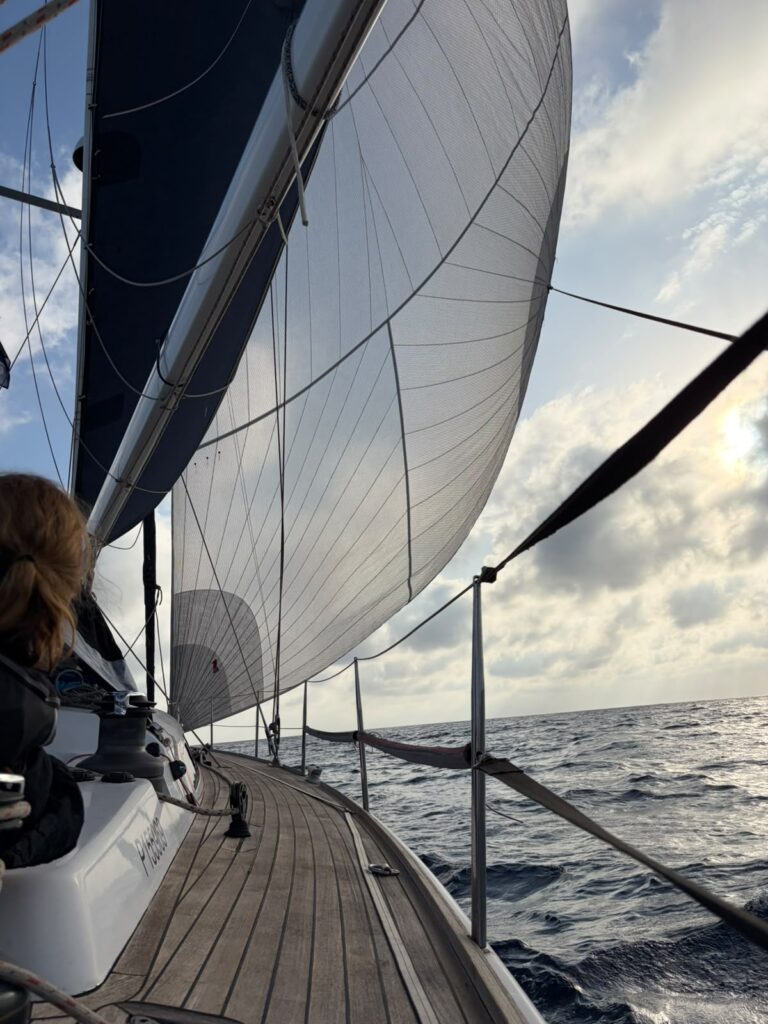
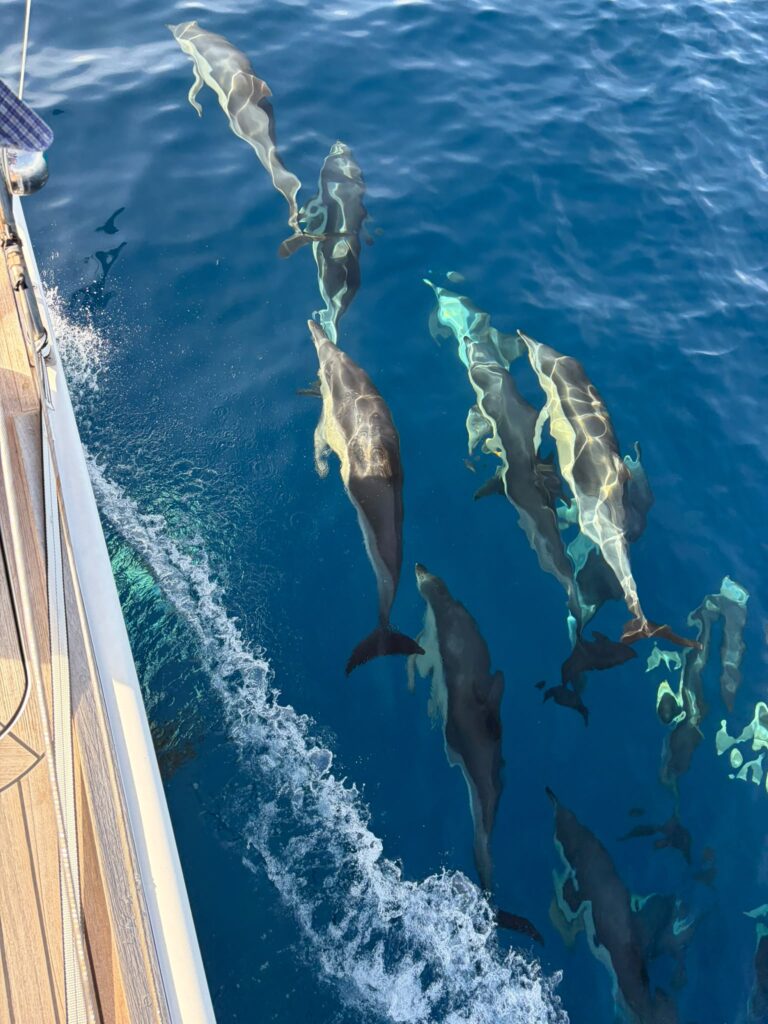
When we arrived in Del Este, the engine wasn’t running properly, but the cause turned out to be clogged filters due to bacteria in the diesel. Jere sorted out the cleaning in the harbour, and in the morning we continued our journey towards Fuengirola. The absolute highlight of what was a rather long day’s sailing was when a pod of dolphins – a large one at that – came to play in the bow waves. It’s always thrilling to see dolphins – they never fail to move you, with the joy and intelligence that shine in their eyes.
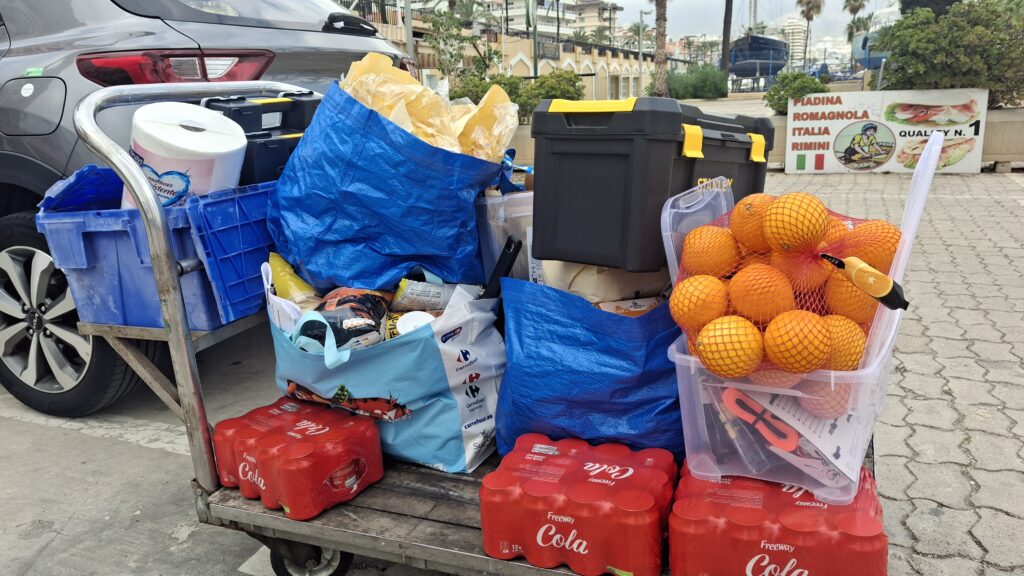
We spent the evening in Fuengirola. The ladies set off for Finland on Friday morning, whilst Jere and I spent a couple more days getting the boat ready and went round the shops doing a massive bit of shopping. We bought some extra food in Fuengirola, and most of the dry provisions for the Atlantic crossing.
- Tommi
Final delivery sailing, Fuengirola – Las Palmas, 835NM, just under 5 days
The ARC racing class requires that a certain proportion of the crew must have at least 500NM of continuous open-sea experience gained within the last 6 months. We agreed to undertake a trial sail from Fuengirola to Las Palmas.
Our schedule was also dictated by the need to time our passage to coincide with a suitable tidal window for Gibraltar and to sail past the orca grounds whilst it was still light.
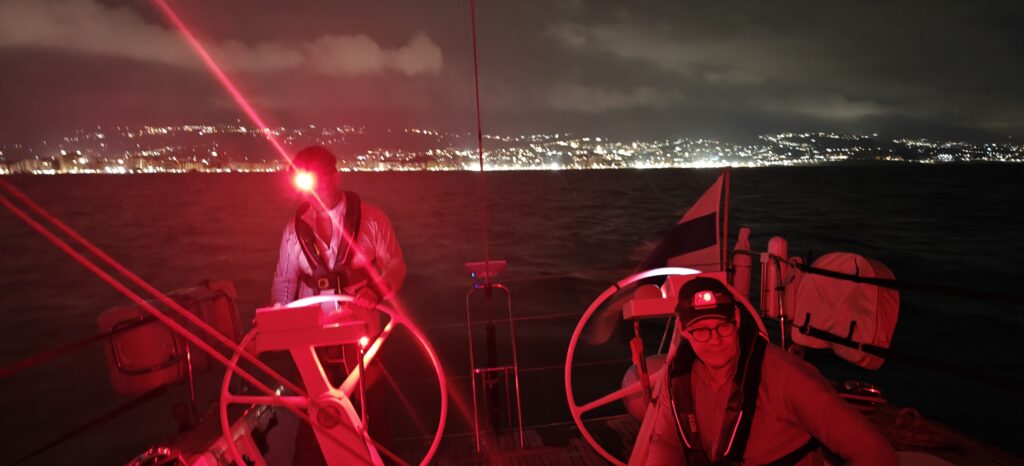
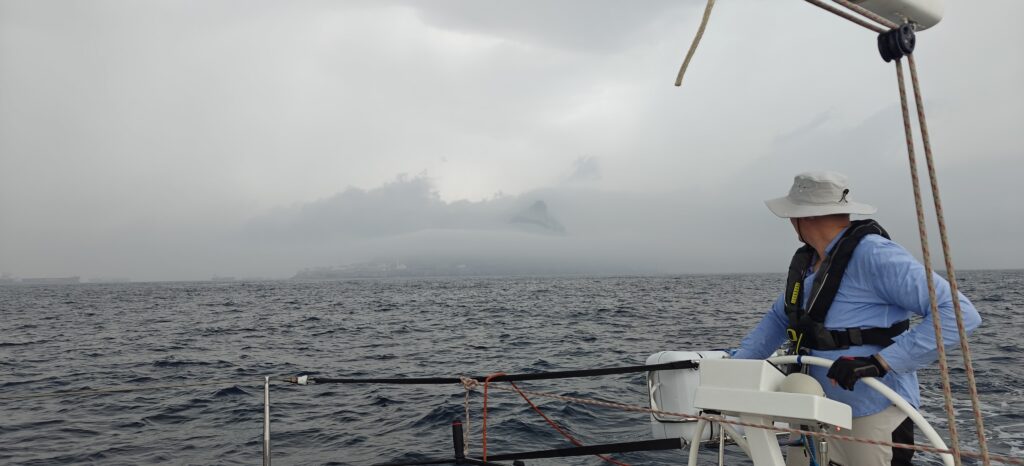
We set off at half past four in the morning, and the winds were favourable for sailing. Gibraltar was, as usual, shrouded in a ring of cloud, and the winds were a bit tricky, so we ended up sailing the final stretch along the shipping lane (so we didn’t cross it directly to the African coast, as the rules require). Although the tide was in our favour, the sea was certainly lively. On those first Atlantic waves, we were already surfing at 15.1 knots. Fortunately, we didn’t spot any orcas at all. Based on online sightings, they had already moved further north.
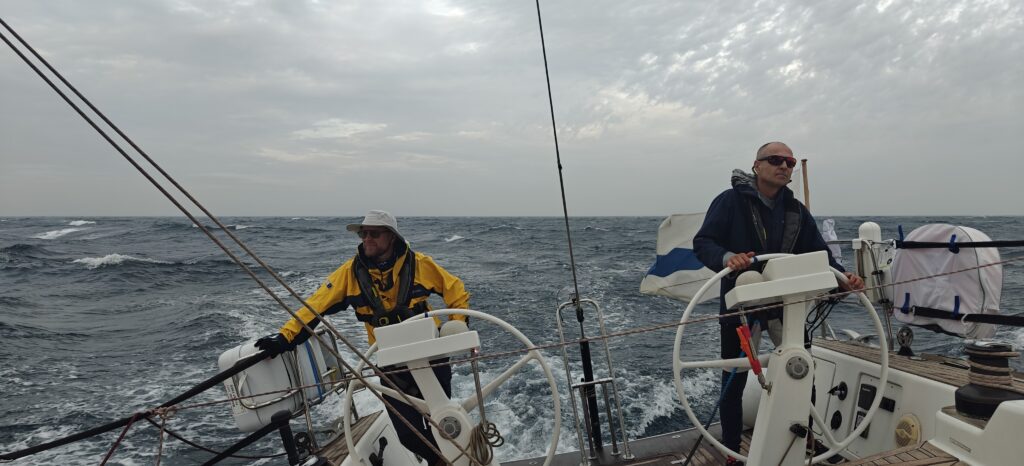
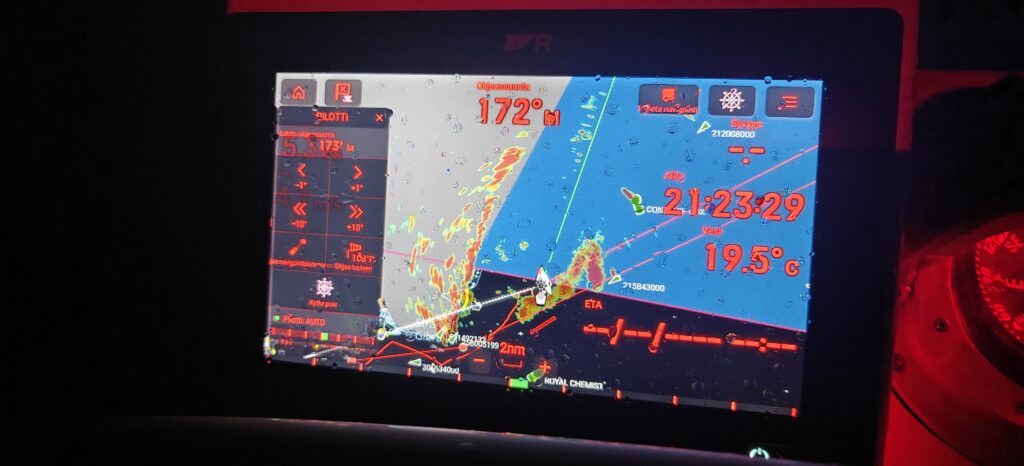
Our first night off the coast of Africa was eventful. At times, a dry foehn wind blowing in from Morocco reached 30 degrees, whilst a cold, damp wind blew in from the Al-Tann. This created thunderclouds and the winds swirled wildly. Our new, high-quality radar enabled us to prepare fairly well for the squalls and navigate around the rain showers.
The temperature was surprisingly chilly due to the rain; long-sleeved clothes were a must. We took turns navigating around thunderstorms, fishing boats and large fishing grounds. Surprisingly, there was plenty to do even though we’d reached the open sea. A large drone even flew over from Morocco to film us, but otherwise, thankfully, it was peaceful.
Our first day on the Atlantic brought a surprise with grey skies and rather chilly weather; mind you, shorts were fine, and the water started to warm up towards the Canary Islands’ 24.5 degrees. During the day, however, it was surprisingly calm; we even motored along to recharge the batteries, whilst testing the watermaker at the same time.
We also got to try out the Code 0 and the A2 in light winds. The food was good, and the cooking rota (based on the principle that everyone cooks and everyone takes a turn at the helm) received praise from everyone. At the same time, we realised that the bow berth is perfectly sleepable even on the Atlantic; there was plenty of room for two there.We also have sea cots in the open deck, so everyone has a place to sleep, although of course at least two (usually three and sometimes four) are on watch.
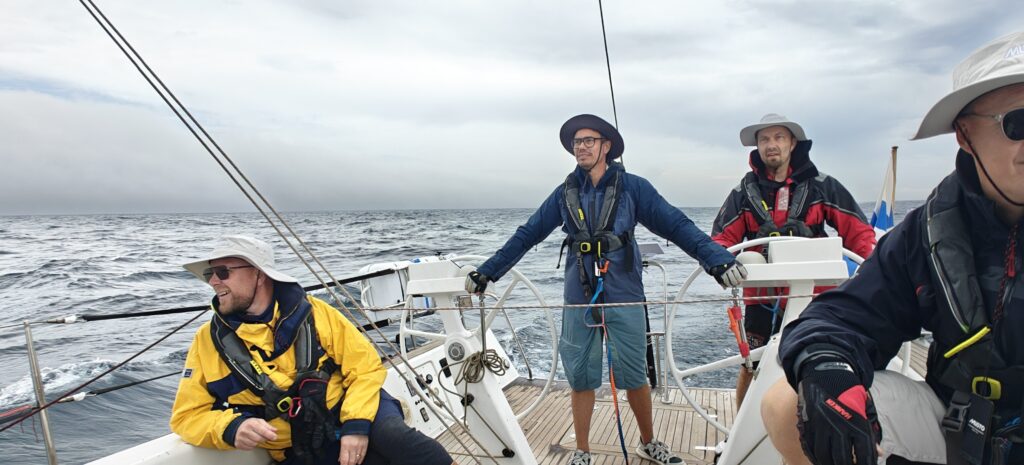
In the evening, the winds picked up again, and thunderstorms flashed on the horizon; we’d opted for the outer route in the hope of better winds, and this allowed us to navigate round the storm fronts quite effectively, so we didn’t end up right in the middle of the lightning again tonight. There were hundreds of flashes, though, and at times they came almost non-stop. Now, however, there were hardly any gusts, even though the wind picked up steadily as we approached the rain front. There was still enough cargo traffic to keep us on our toes whilst monitoring both the radar and the AIS display.
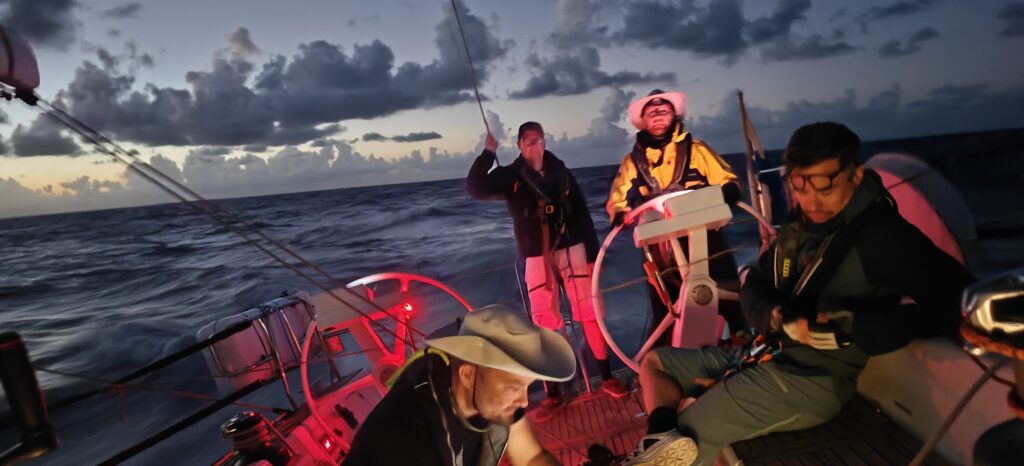
On the third day, the sun was shining and the weather warmed up nicely, just right. The sunrise and the whole day were beautiful. A brief lull in the wind allowed us to go for a swim in the waves of the Atlantic, which was about 3 km deep. We ate pancakes and everyone really enjoyed the trip out to sea.
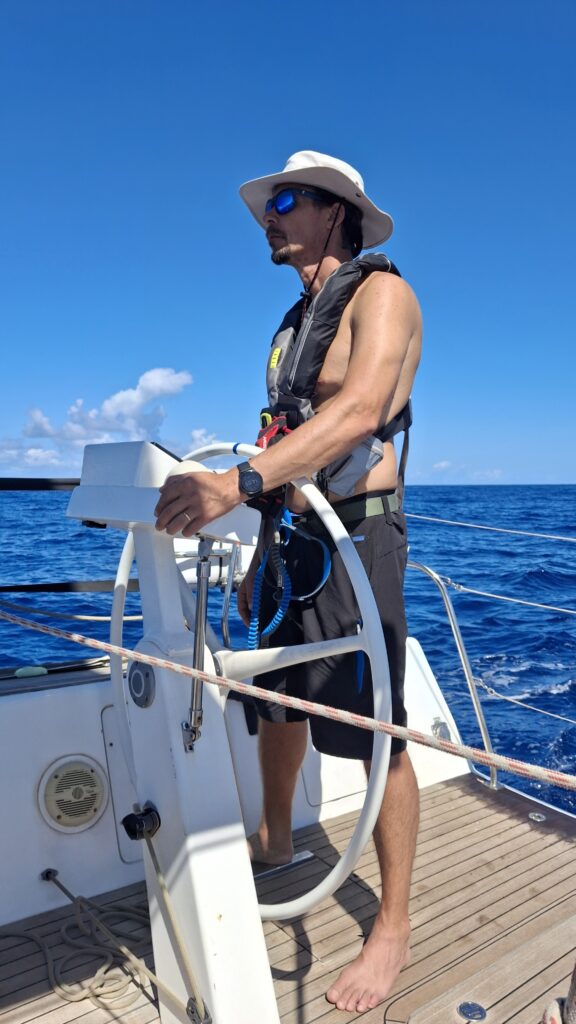
The evening gave way to a beautiful sunset and a lovely night. It was thrilling to gaze at the changing starry sky; the past few nights had been bright only by the light of the stars. The clouds appeared as dark patches, and the sky was a deep blue as the stars shone. For example, the Big Dipper only came into view in the early hours of the morning, rising majestically from the sea with its ‘ladle’ leading the way. The stars were truly bright and seemed somehow further apart. The Milky Way shone magnificently across the sky. It was magical to sail through the black night along the path of the Milky Way, accompanied by the sounds of the roaring stern and the lapping bow.
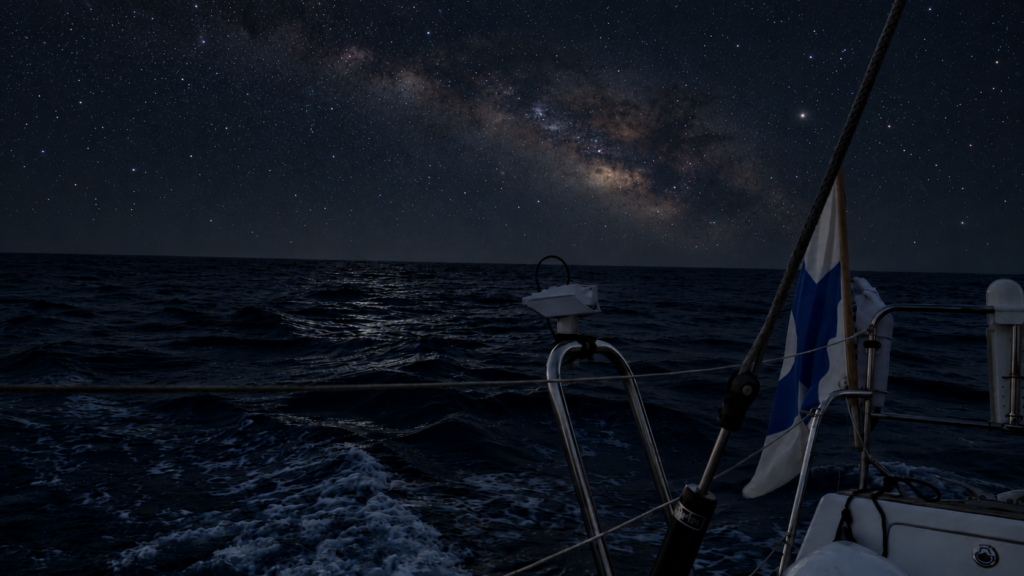
(The sky in the image has been edited)
The name ‘Birds Trail’ derives specifically from the mythology of Eastern Finland and Northern Eurasia (the name is the same in Finnish and Estonian, whilst in Northern Sámi it is ‘the bird’s stairs’). This is because, particularly in autumn, the Milky Way lies in the same direction as the migration routes of birds (such as swans).
It was believed that birds flew along the Milky Way to Birdshome, a mythical warm land at the edge of the world (that’s where we were headed, too). Seen from Finland, there was a gap at the boundary between the sky and the earth through which the birds could pass to spend the winter.
In Finno-Ugric cosmology, the Milky Way and its stars might also have been seen as a vast flock of migratory birds, with the stars representing human souls on their journey to the afterlife. In this way, the migration of birds was linked not only to the changing seasons but also to the cycle of life and death.
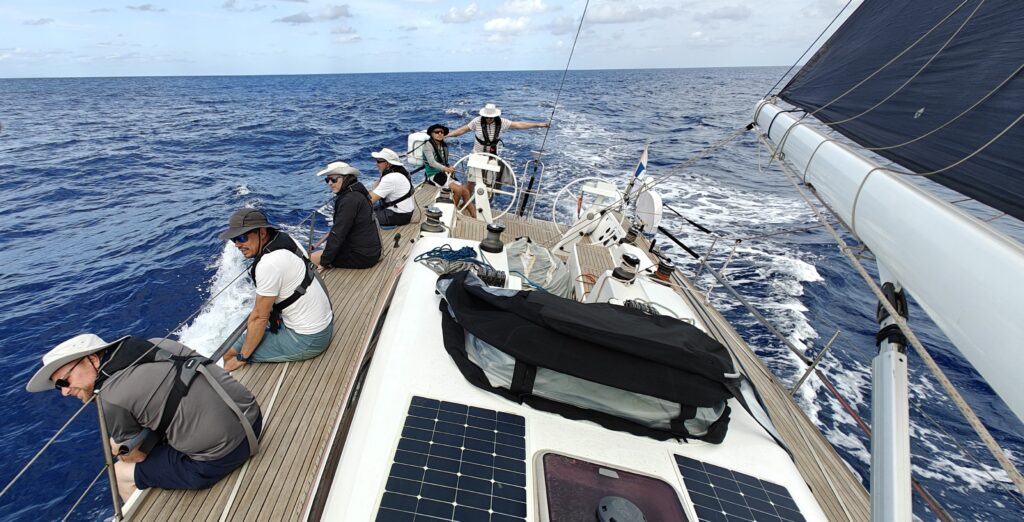
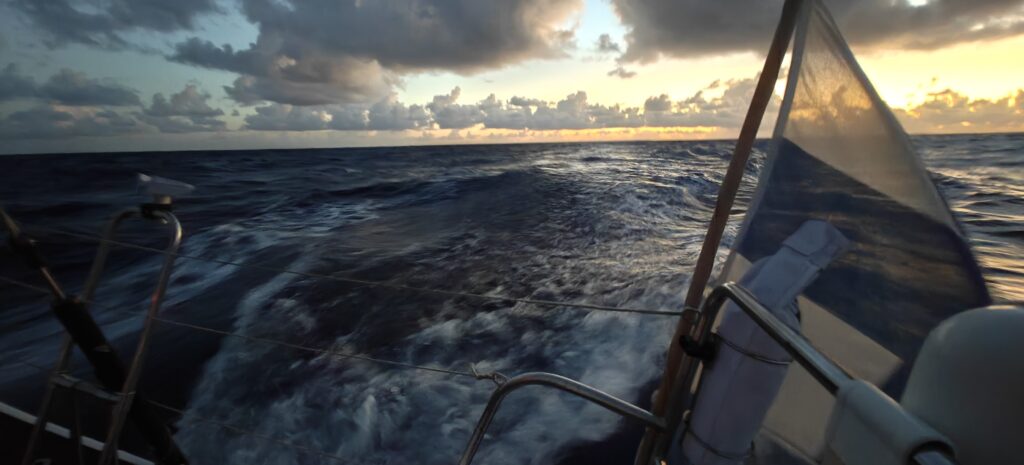
On the last day, the winds shifted to a more favourable direction, and we were able to sail the A5 on the Genaager in moderate swells. It was good practice for the crossing itself, both throughout the day and into the night. We had to stay alert at the helm for an hour to ensure we didn’t get too far upwind (we came close to broaching on a couple of occasions) or end up in an accidental jibe (we had a few of those too), as waves of about 2–3 metres were pushing the boat from behind. Thanks to the stars and good instruments, we managed to maintain a good heading, and gradually each helmsman got the hang of it. During the night, we had some brilliant bursts of speed on the A5, reaching up to 13 knots, though those trying to sleep didn’t necessarily appreciate the boat’s rolling. But this is a good starting point from which to set off on a long voyage with a bit more experience under our belts.
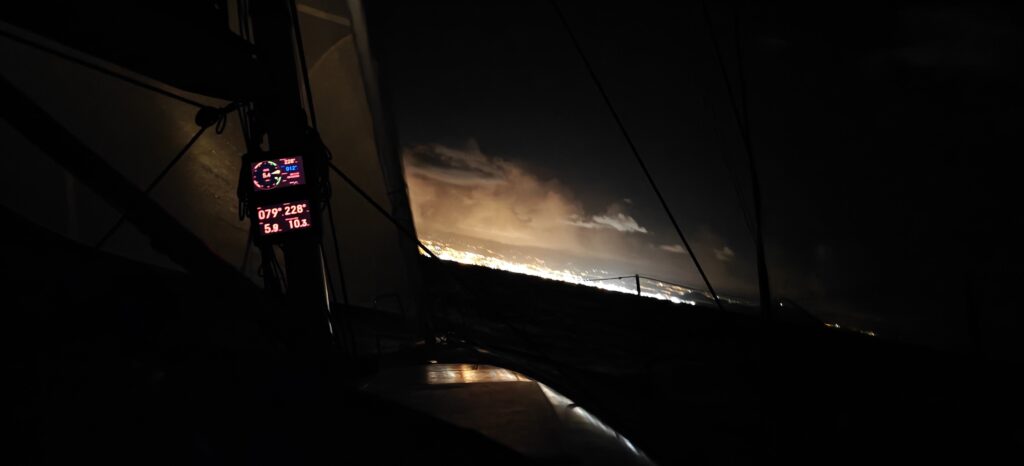
As the dusk fell, Juuso shouted, “Land in sight!”, and sure enough, the lights of our destination, Gran Canaria, began to shine on the horizon. Some of those on night watch, a little impatient, stayed on deck; we would soon be there. The night was long, however, and a nap was needed; the sails were not lowered until after four o’clock off the coast of Las Palmas, and we sailed into the customs quay with everyone awake. We had radioed our arrival in accordance with the regulations, and the customs operator in Las Palmas welcomed us.
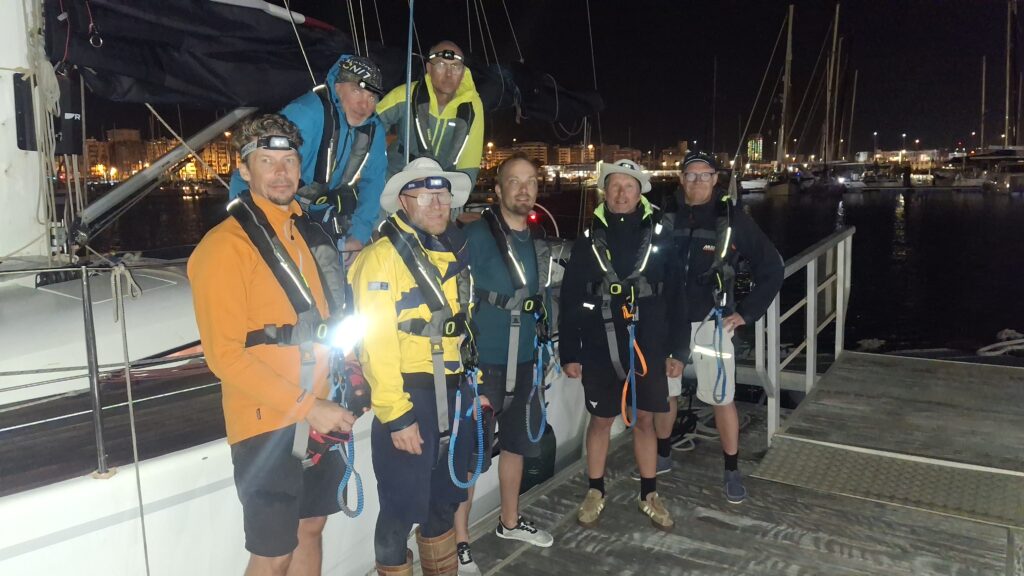
After the usual morning checks, we arrived at ARC’s main jetty (L/10) at berth 12 – feel free to come and have a look at the boat. Now our long-held dream of crossing the Atlantic is really starting to feel real, and the culmination of this two-year project is just around the corner.
We spent a couple more days getting the boat ready – fitting the sail numbers, securing the rigging and sails, and sorting out all the little bits and bobs that a boat needs. Then off to Finland and back in November!
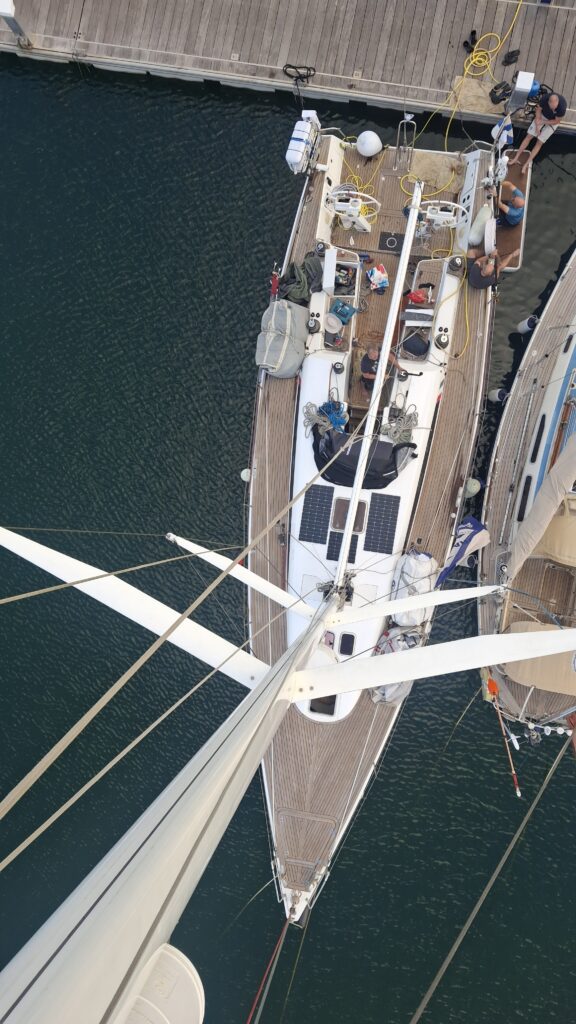
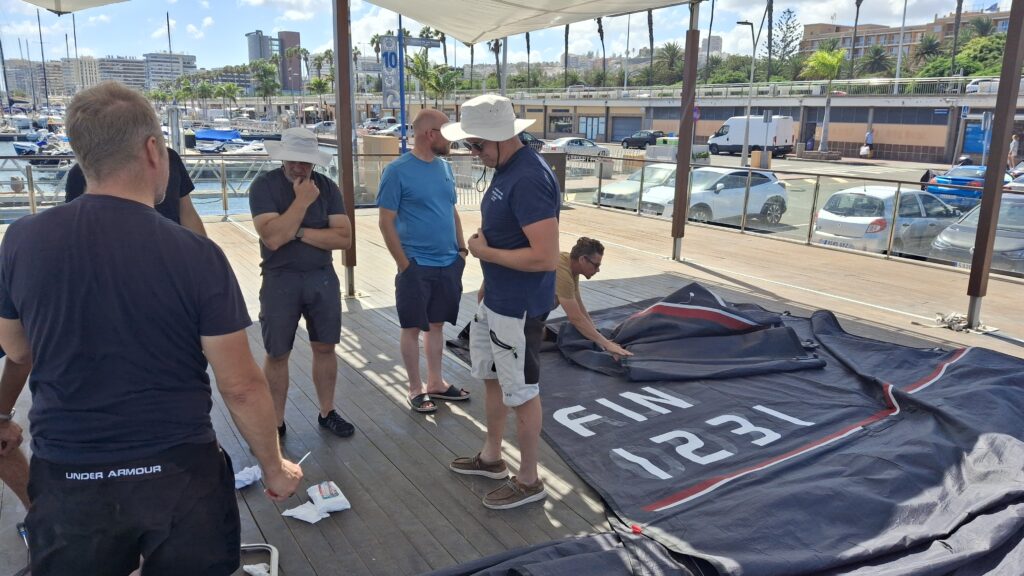
Written by: Tommi
You can also find videos and photos of our sailing trip on our Instagram account @sybluemoon.fi
Worktrip and moving to (trying) Spain
Antti and Juuso set off from Oulu on Saturday 9 May 2026, heading for Helsinki, from where they flew on to Nice. They packed four hold bags for the journey, one of which was a ski bag filled with Webasto air tubes and the frame tubes for the sprayhood. The luggage also contained new fridge components, a compressor and an evaporator. As for tools, it is worth mentioning the random-orbit sander, which Antti used to sand the deck of the ruff before painting it. From Nice, the men travelled by train with their luggage to Toulon, where they hired a car for our use
On Monday, work began with a few hours’ drive to find deck paints and supplies. After that, Juuso started fitting the fridge and Antti began sanding the deck. On Monday, Harri flew from Helsinki via Amsterdam to Marseille, from where he continued his journey by train to Toulon. There is a convenient water bus service from Toulon to La Seyne for four euros, and Harri took advantage of this in the afternoon. Tommi had left Oulu on the same day, travelling via Helsinki and Nice to Toulon, from where he was picked up by a hire car and taken to the cabin in La Seyne.
On Tuesday, the boat was a building site, with fitting-out work in progress all over the place. Antti was painting the roof of the deckhouse. Harri was tinkering with the cabling and instruments, and Juuso was putting the finishing touches to the fridge installation. Fitting out and maintaining the boat is a challenge when you’re far from home, in a foreign culture and with a limited supply of tools.
On Wednesday afternoon, the boat was launched and the fitting-out work continued. The plan for Thursday was to set sail for Spain. In the evening, Arto, Jere and Timo arrived in Toulon, having travelled the familiar route to France by flying directly from Helsinki to Nice. The crew was now complete. However, the life raft and life jackets sent from Helsinki on 12 May did not arrive in La Seyne in time.
Friday, the day of departure:
Tommi arranged with DHL that we would collect the parcels ourselves from Marseille on Friday. Antti and Tommi set off for Marseille on Friday morning in a hire car to collect the parcels; to their surprise, the lifejacket parcel was nowhere to be found. In anticipation of this, the crew had brought their own lifejackets from Oulu for the transfer sail. The new life raft was loaded onto the boat and preparations for the transfer sail began. The journey to Spain would take about three days.
The wind was brisk, at 15–20 m/s. We knew we were in for rough weather on our first sail. Let’s see how the boat and crew hold up. We cast off from the RC Marine jetty at around 2 pm. The atmosphere was excited and tense – finally sailing with our own crew!
We hoisted the sails off the coast of Toulon and headed out to sea; there were only a few other vessels about due to the storm, and we too had to reef the sails as soon as we reached the open sea. We came across a boat with a broken sail. As we moved out to the open sea, the jib broke another stay, so we also reefed to the second reef and rolled the bow out just a little. The waves were sharp, and an hour later we got to practise hoisting the storm jib whilst the waves were washing over the deck. Spirits are still high, though – the boat’s handling the strong wind brilliantly!
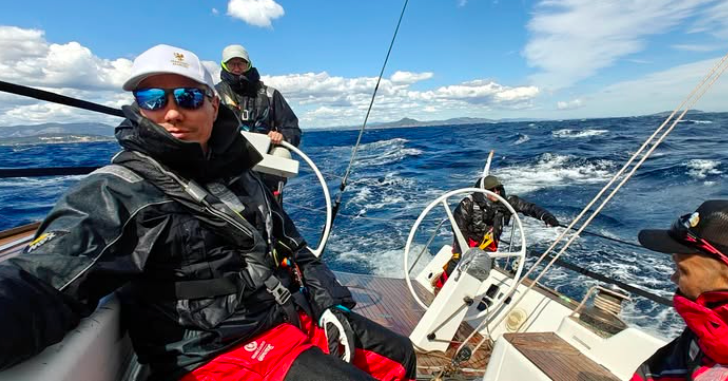
After about two hours, the waves are already around four metres high, and we’re making good headway; the rig is working well, and even though the crew are already getting wet, the atmosphere is great. Suddenly, there’s a loud bang from the upper rudder bearing; the upper bearing mount fails and the rudder makes a visible movement on the deck. A quick assessment of the situation, and we turn back towards our home port. The rudder seems to be working, but we start preparing for the worst; in a heavy storm, losing the rudder would mean the boat being blown into the wind and perhaps even being lost.
Jere sets off with Harri to contact the maritime rescue service, which they manage to do after a few attempts. We report the situation and our coordinates, and after a brief discussion, they say they’ll come and assess the situation. We sail along with the current in a somewhat subdued mood; the rudder responds well to the helmsman’s commands, whilst night falls all around us.
We spot the coastguard boat heading at high speed towards our original position, and once again we try to break through the language barrier of English and French to tell them that we’ve spotted them and that these are our new coordinates. Inside, whilst making radio contact, the boat is pitching and rolling, and as we peer at the small latitude and longitude figures, both radio operators take turns to trow-up. Harri has strong stomach and even ends up having to clean up the mess.
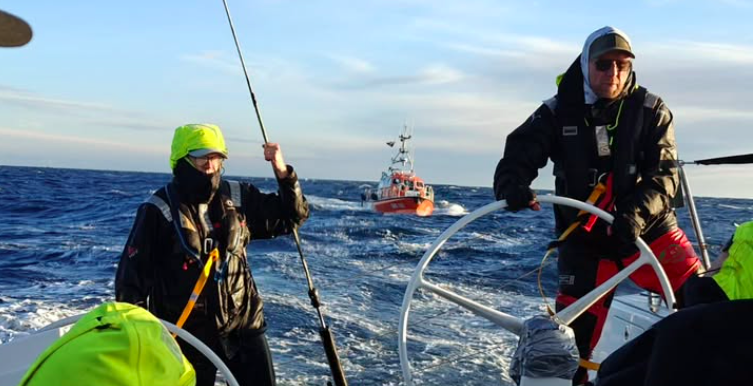
Before long, the lifeboat is right behind us, following our course towards the shore, and after about an hour we realise that we’ll be able to make it back on our own. Late at night, we head for the town jetty at Le Seyne and go to bed.
On Saturday morning, we assess the situation and decide to repair the upper bearing mount. After a trip to the shops, our skilled mates carry out a brilliant repair and we discuss what to do next. We decide to set off on another leg of the journey; after all, the wind has died down a little (still 15 m/s) and, although the waves have grown, they are longer. With great enthusiasm, we bid farewell to France once more and set off for Spain!
The sailing was a bit calmer, once again under storm sails and with a large new storm jib; the boat handles beautifully in a headwind or crosswind, the watches are starting to roll, and the first night watch is on deck. Tommi is at the helm and Antti notices that the fastening isn’t holding! The rudder shaft is grinding against the upper bearing. Now skipper Arto lets out a quick, terse shout as he rises from his bunk: ‘If it’s broken, we’re heading back to port. The boat turns 180 degrees to head back; big waves of about 4 metres are fuelling the journey home, and the pleasant surfs of nearly 13 knots aren’t exactly a cause for celebration at this stage.
Back at the same harbour on Sunday night, and off to bed. During the day we made new plans; most of the crew are heading home on Monday (via a long detour, with flights waiting in Alicante), whilst Tommi and Harri are taking the boat back to the shipyard, and will follow on Tuesday. We’re feeling a bit down, so we’ll do some cleaning and washing.
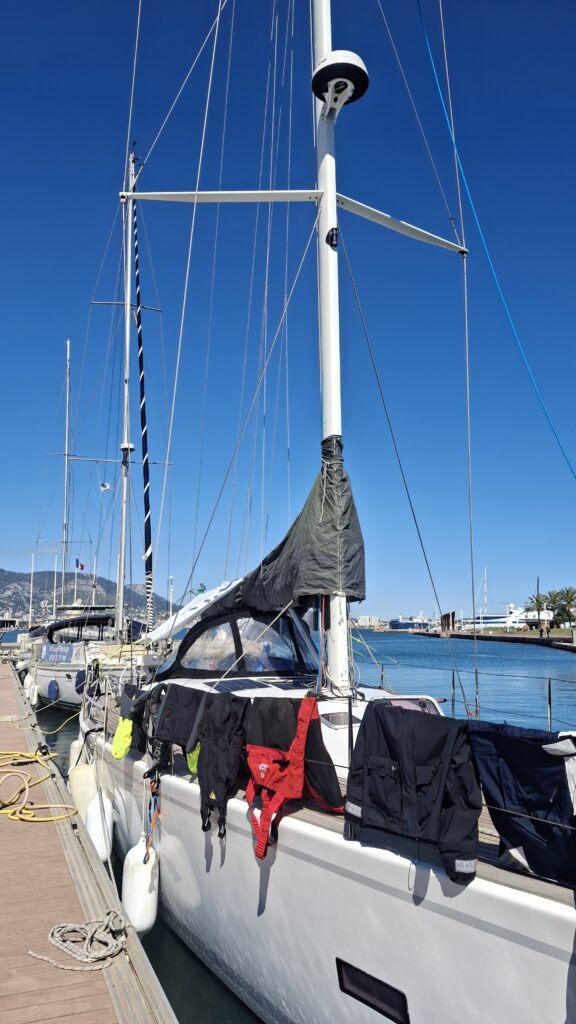
The boat will be taken to the shipyard on Tuesday morning, and a few weeks later Arto and Harri will be coming round to replace the entire rudder bearing assembly with a more robust set. The cause of the problems was seized rod bearings in the lower bearing; the boat has seen little use in recent years, with only a few sailing trips and mostly stored out of the water; the move to Spain will not take place until July.
Working trip in April 2026
Working trip 26–30 April 2026: HKI–NCE–HKI. Arto, Harri and Janne set off on the trip
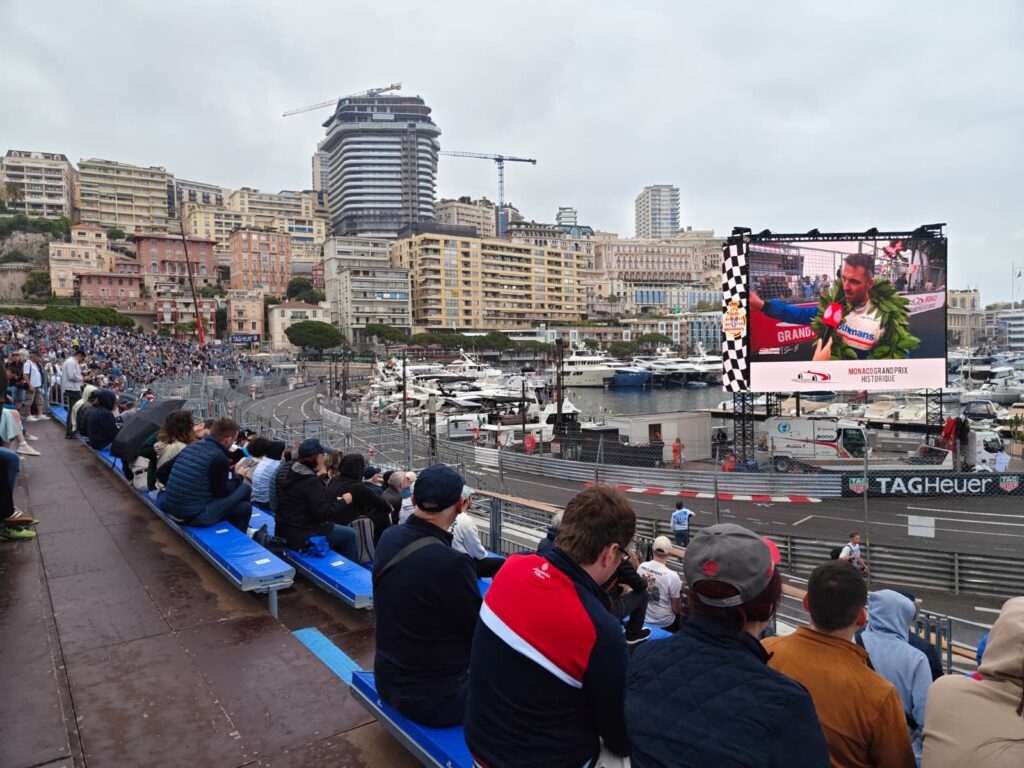
Our flight to Nice landed on Sunday morning. As the marina was closed on Sundays, we decided to drive to Monaco in our hire car. To our surprise, the Monaco Historic Grand Prix was taking place. We went to hang about by the gates of the spectator area, listening to the sounds, breathing in the smell of petrol and catching a glimpse of the vintage racing cars whizzing past. The threat of rain had put off a friendly couple from watching the race, so they gave us a couple of tickets to the Formula One event. We bought a third ticket and made our way to the stands with our fingers pressed against our ears. We got to watch Formula cars from the 1950s to the 1980s racing on the legendary Monaco street circuit, at the Tabac bend off the harbour. A familiar name, K. Rosberg, was taped to the side of one of the cars. Early in the evening, we arrived at our accommodation after a couple of hours’ drive on the motorway. The host charged us an extra €20 for our late arrival, but he fully understood the enthusiasm of us balding men for historic Formula cars.
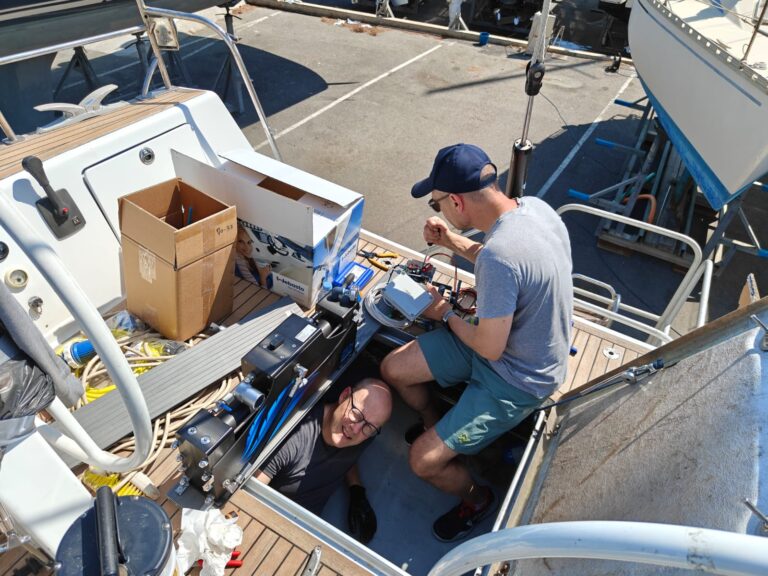
Monday morning began with us opening the parcel we’d sent from Helsinki, which had arrived at the RC Marine hall. All the equipment had arrived in one piece. The morning was spent carrying several cardboard boxes onto the boat and clearing any excess items off it. The equipment to be installed included: a Schenker Zen30 watermaker, a Webasto AirTop Evo 40 heater, Raymarine Axion series chartplotters, mast-mounted displays and a radar, Sunbeam System lithium batteries (3 x 10⁸ A), solar panels and Moonray controllers, a Victron battery monitor and USB sockets in the cabins. The original VHF radio had to be replaced so that we could programme the vessel’s own MMSI number into it. The radio was purchased from a local marine supplies shop for €269. Tracing the routes of the heating system’s air ducts, the wiring harnesses and the water hoses through the bulkheads and fittings caused a great deal of headache, drilling and dismantling of fittings. Drilling holes in a boat is, by its very nature, a risky business. The key point when drilling is to measure twice and drill once – preferably rather than the other way round. When drilling with a countersink bit, you must check that the centre punch has made a mark before drilling through the countersink bit.
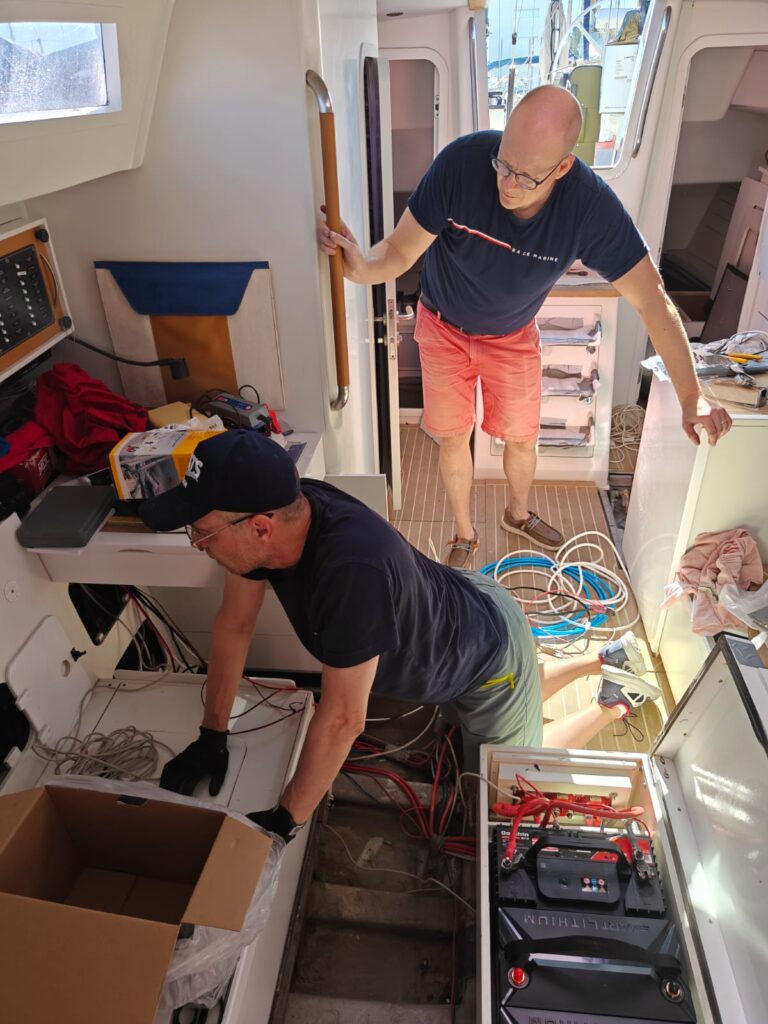
During the unpacking and dismantling of the fittings, the boat is rather like a small house during the installation of kitchen units, with tools and fittings constantly going missing and bits and bobs strewn about. Space for technical equipment on a boat is limited, and the aim is to conceal everything as much as possible. Makita’s cordless vacuum proved to be an excellent tool, allowing us to clear away drilling dust straight away. The exciting tinkering made the fitters lose track of time; on many occasions, we realised after midday that hunger and thirst were significantly impairing our ability to function. The locals were, of course, taking their siesta at this stage. The shipyard area closed at 6.30 pm, at which point we set off on a hunt for supplies at hardware shops and specialist retailers. Hours of crawling and scrambling began to pay off, and by Wednesday the instruments and control panels were in place. On Thursday morning, we handed back the flat, finished off the installations on the boat, collected the packaging waste for recycling and secured the boat’s hatches. We drove to Nice in our hire car and caught our return flight to Helsinki.
The origins of the project and the purchase of the boat
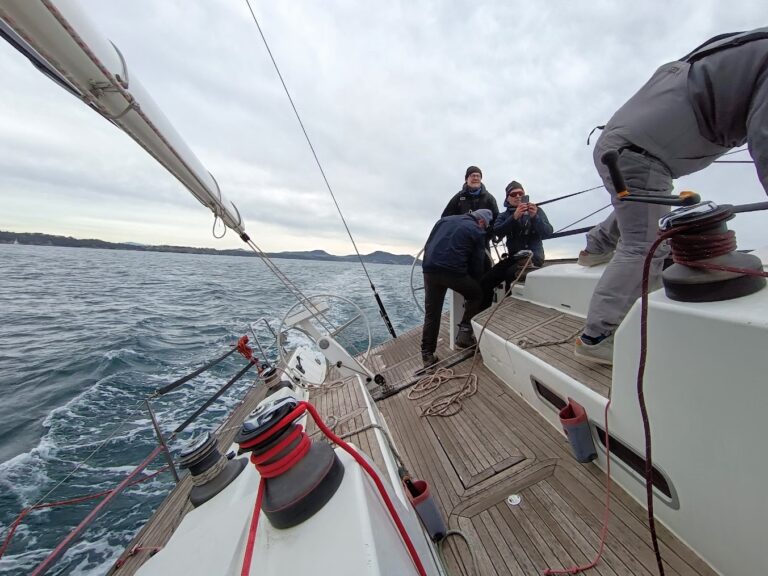
These friends from Oulu have long dreamt of sailing the oceans together. It all began back in 2003, when Arto bought a share in the Sirena 38 s/y Sunita, which was set to take part in the ARC 2006 race. Some of the friends took part in the 2006 transfer voyage from Oulu to Kiel aboard the s/y Sunita, skippered by Arto and sailing under the sponsor name ‘Tracker My Way’. That was when a shared dream of an ocean crossing with their own team was born. When Arto returned from the ARC 2006 race, enthusiasm for crossing the Atlantic grew stronger; however, at that time, many of them were in a situation in their lives where it was not yet possible to carry out the project. Since then, however, the group has been sailing together on offshore trips in the Gulf of Bothnia for some twenty years. The lads have made it a tradition to organise an annual sauna evening at the end of the sailing season. In autumn 2024, it was decided to put the ARC project into practice, based on the idea that if we didn’t set off now, the trip would soon be out of the question, as we’d be too old and wouldn’t dare set off at all.
The process of researching and searching for a suitable boat model began. The aim was to acquire a reasonably modern, fast and live-aboard sailing boat. Arto drew up an Excel spreadsheet listing the boats available on the market. The spreadsheet included the boat’s type, length, year of manufacture, asking price, location, draught and additional details. Arto has long enjoyed keeping an eye on racing/cruising sailing boats for sale online, as competitive sailors generally do.
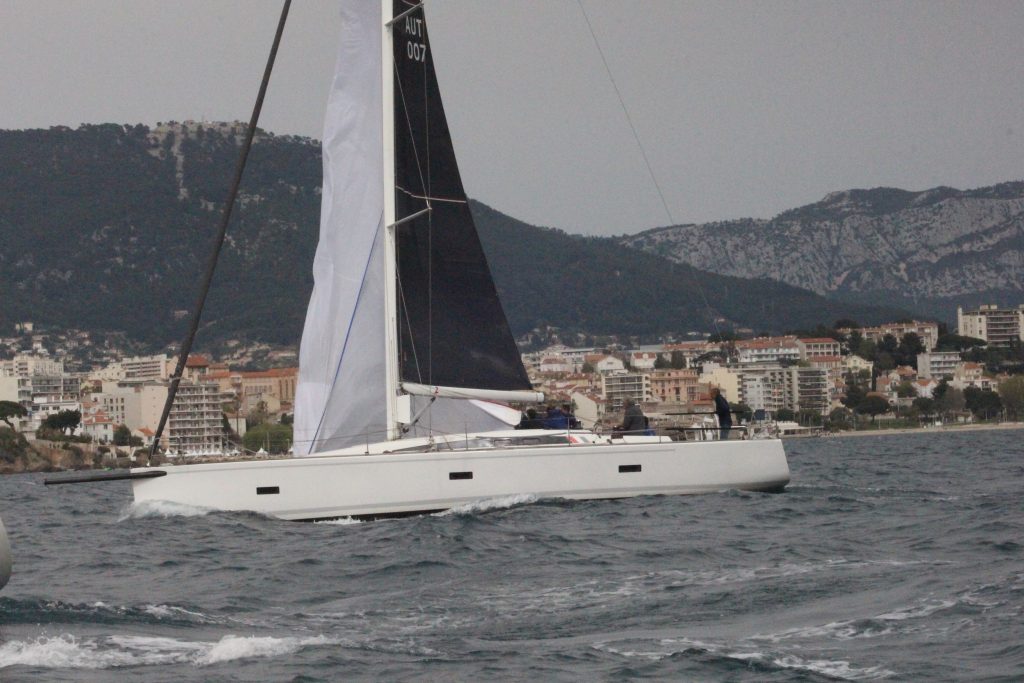
The SLY 47, a yacht model designed by the Italian firm Studio Lostuzzi Yacht Design and built by the SLY Yachting shipyard, attracted a great deal of attention. In June 2025, a reconnaissance team comprising Arto, Harri and Tommi was sent to Spain, near Valencia, to view and test-sail an SLY 47 named Avis. The test sail took place in light winds, and the boat proved to be very responsive and a joy to sail. Its ability to accelerate from a gust was evident, which is a very demanding requirement for a boat of this size. However, this particular boat did not prove to be the right fit for us. On the same trip, we also took a quick look at a 2002 Grand Soleil 45, which was in excellent condition. An X-46 in superb condition came up for sale in Finland, which Arto went to view, but the SLY 47 was still on the team’s mind. In Italy, there were a total of three SLY 47s during the 2025 season, all of which were sold before we even had a chance to view them.
In autumn 2025, the s/y Blue Moon SLY 47 was up for sale in France. Arto, Harri and Harri’s son Asla set off on 21 November 2025 for La Seyne, near Toulon, to view the Blue Moon and, whilst on the same trip, to see a Gemini 52 in Imperia, Italy. Following this trip, the choice of boat was clear, and they decided to make an offer for the Sly 47 s/y Blue Moon. The Blue Moon had seen little use over the past five years, so it required some refurbishment and fitting out for the Atlantic crossing. In early December 2025, an offer was made for the Blue Moon, which the seller accepted fairly quickly. The boat sale was all but finalised, pending a trial sail. After the Christmas holidays, we began planning the trial sail. On 18 January 2026, Arto, Juuso, Timo and Tommi flew from Rovaniemi to Nice, from where they continued their journey by hire car via Monaco to La Seyne, where the Blue Moon was moored at the RC Marine shipyard. When we set off from Rovaniemi, it was 20 degrees below zero and the trees were covered in hoar frost – proper winter weather. The Jet Time flight was delayed by three hours, which meant we had to make new arrangements for the hire car and accommodation. In Nice, it was a warm +12 with a strong wind. A winter storm and the Mistral were raging across the Riviera. Unfortunately, the test sail had to be cancelled due to the stormy winds; the shipyard foreman refused to launch the boat, and the crew didn’t feel like going out to sea at that time either. The visit was nevertheless useful in that people other than Arto and Harri got to see the boat in person. During the same visit, the necessary repairs were finalised.
The next test flight was planned for February. Arto, Harri and Tommi travelled from Helsinki via Frankfurt to Nice on 11 February 2026. Once again, the threat of a winter storm loomed. As the flight approached Nice airport, strong winds forced the pilot to take the plane back up into the air. We stopped in Milan to refuel the aircraft and returned to Nice a few hours late. The weather forecasts predicted a storm in the Riviera region; only on Friday would a test sail be possible. The boat broker, Vincent, had already launched the boat on Monday whilst the wind was light. There were storms on Wednesday and Thursday, but fortunately on Friday the wind died down to normal sailing conditions, so we were able to take the Blue Moon out for a trial sail. As well as Arto, Harri and Tommi, the trial sail was attended by the boat’s former skipper, a crew member, the broker Vincent and a manager from the brokerage firm. It was a pleasure to sail with the French. The boat proved to be a fun sailing vessel; indeed, it accelerated well in gusts and turned well into the wind. At the same time, some functional shortcomings in the electronics and other technical systems were revealed. These had been taken into account in our offer price. After the trial sail, the boat was hauled out immediately, as a winter storm was on its way again. The boat sale was finalised and preparations for the refurbishment began.
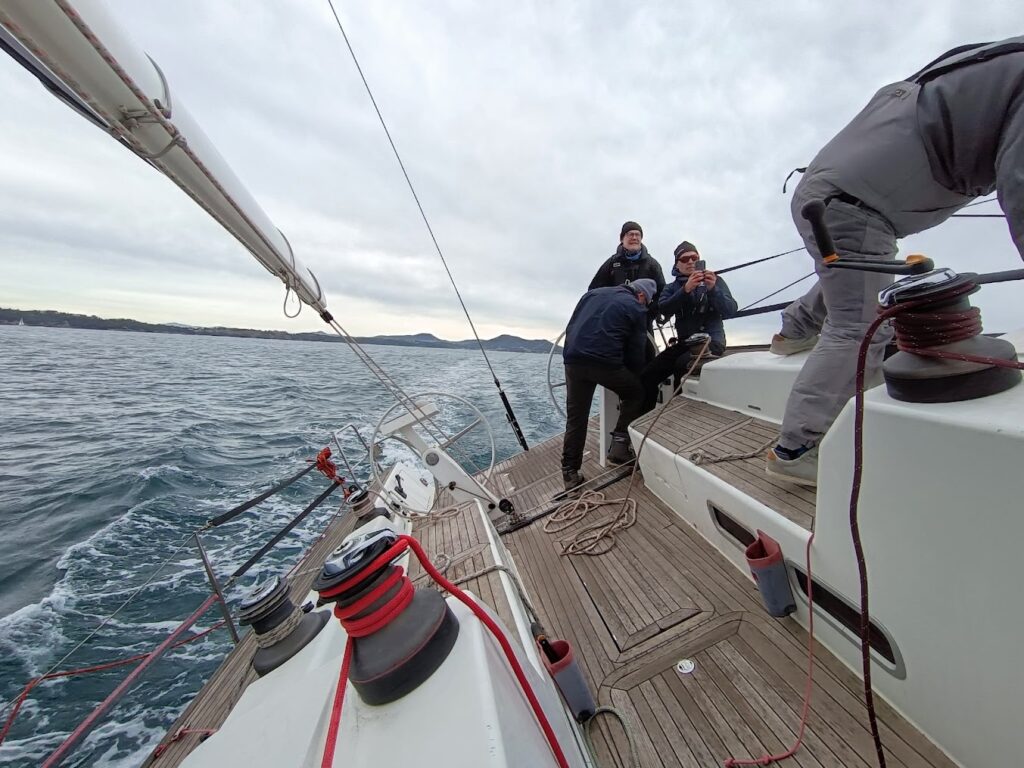
We decided to have the French carry out the sanding, filling and painting of the hull. We also had them clean, sand and treat the teak deck, as well as sand and wax the sides. In addition, we had the base of the mast laminated, repairs and modifications carried out on the pedestals, and the engine serviced. At the sailmaker’s, we had two additional reef points added to both mainsails and purchased a storm jib to be hoisted over the furled headsail on the bow, which proved useful on our very first long-distance sailing trip.
A week of sailing in the Caribbean
Spend an unforgettable week sailing in the Caribbean islands.
Completely refurbished for the Atlantic crossing, S/Y Blue Moon offers a unique opportunity to enjoy the company of friends,
the sun, the sea and sailing in Caribbean.
Sponsorship
Finland is home to the world’s northernmost active sailing culture. However, awareness of this culture is low, but this can be improved.
The project raises the profile of northern sailing culture both locally and internationally.